The Complete UK Guide to Campervan Awnings (Fiamma, Multi-Rails & Setup Advice)
You love your campervan - but trips don’t always feel as easy or relaxed as you imagined. And in the UK, the weather has a habit of flipping on a dime - rain one minute, bright sun the next - which makes quick outdoor shelter essential.
Maybe it’s drizzling (again), and instead of sitting outside with a coffee you’re hunched inside, stepping over shoes, wet coats, and bits of kit that really shouldn’t be there. Or maybe you’re cutting a stop short because there’s nowhere comfortable to cook, change, or just exist once the weather turns.
If that sounds familiar, the issue usually isn’t the van - and it isn’t even the weather.
It’s a lack of usable outdoor space.
Not bigger space.
Not fancier space.
Just space you’ll actually use, every trip, in real UK conditions.
This is usually the point where people start researching campervan awnings - but before buying a campervan awning in Cornwall, it’s worth understanding what you actually need, because not every van needs the same setup.
In This Guide:
Why Most Vans Struggle With Outdoor Space
The 2 Main Types of Campervan Awning
Wind-Out vs Drive-Away: Detailed Comparison
Which Setup Suits Your Travel Style
Real-World UK Factors That Change the Decision
Can You Start Simple and Upgrade Later?
FAQs
The Real Problem Most Vans Have (And It’s Not the Weather)
UK weather gets blamed for a lot - but plenty of vans handle the same conditions just fine.
The difference usually comes down to how quickly and easily shelter can be created.
Outdoor space only works if it’s quick, easy, and realistic for how you travel.
If creating shelter feels like effort, it won’t get used - and that’s where many campervan awning purchases go wrong.
Understanding this difference is what separates a good purchase from a frustrating one.
The Two Main Types of Campervan Awning (And Why They’re Not the Same)
When people say “campervan awning”, they’re often talking about two very different things.
Understanding this difference is what stops you overbuying - or buying the wrong setup entirely.
Broadly, most campervan outdoor shelter falls into one of these categories:
A permanently mounted wind-out awning
A detachable drive-away awning that attaches via a multi rail (such as a Vamoose awning rail)
Both create shelter.
But they behave very differently in real-world use.
Best for…
Wind-Out: Weekend trips, short stays, fast setup
Drive-Away: Families, longer stays, basecamps
Not Sure: See “Real-World Factors” section
Fiamma Wind-Out Campervan Awning
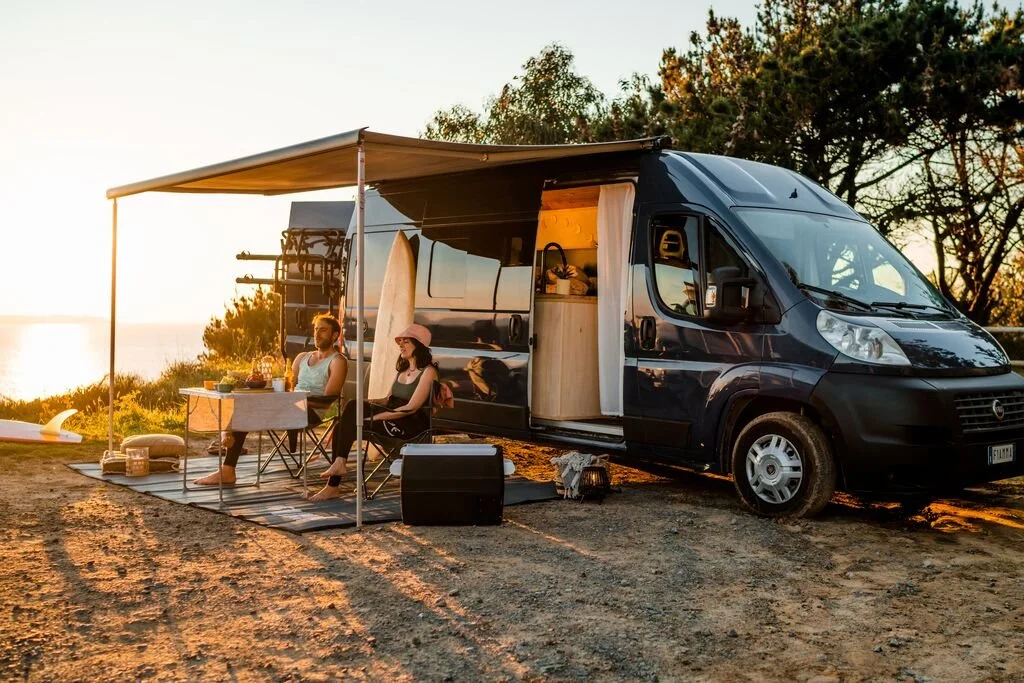
A Fiamma wind-out campervan awning is permanently mounted to the side of the van and rolls out in minutes, making it one of the most popular fixed awning options for UK campervan owners.
You park up. You wind it out. You’ve got instant shelter.
The main benefits:
-
Ideal for short stops, beach days, lunch breaks, and one-night stays.
-
It lives on the van - no bulky fabric bag taking up space inside.
-
Perfect for cooking, sitting out, or keeping wet gear outside the van.
-
Because it’s so quick, people actually use it - even on short trips.
-
When properly installed, it becomes part of the van rather than an add-on.
Drive-Away Campervan Awning (Using an Awning Rail)
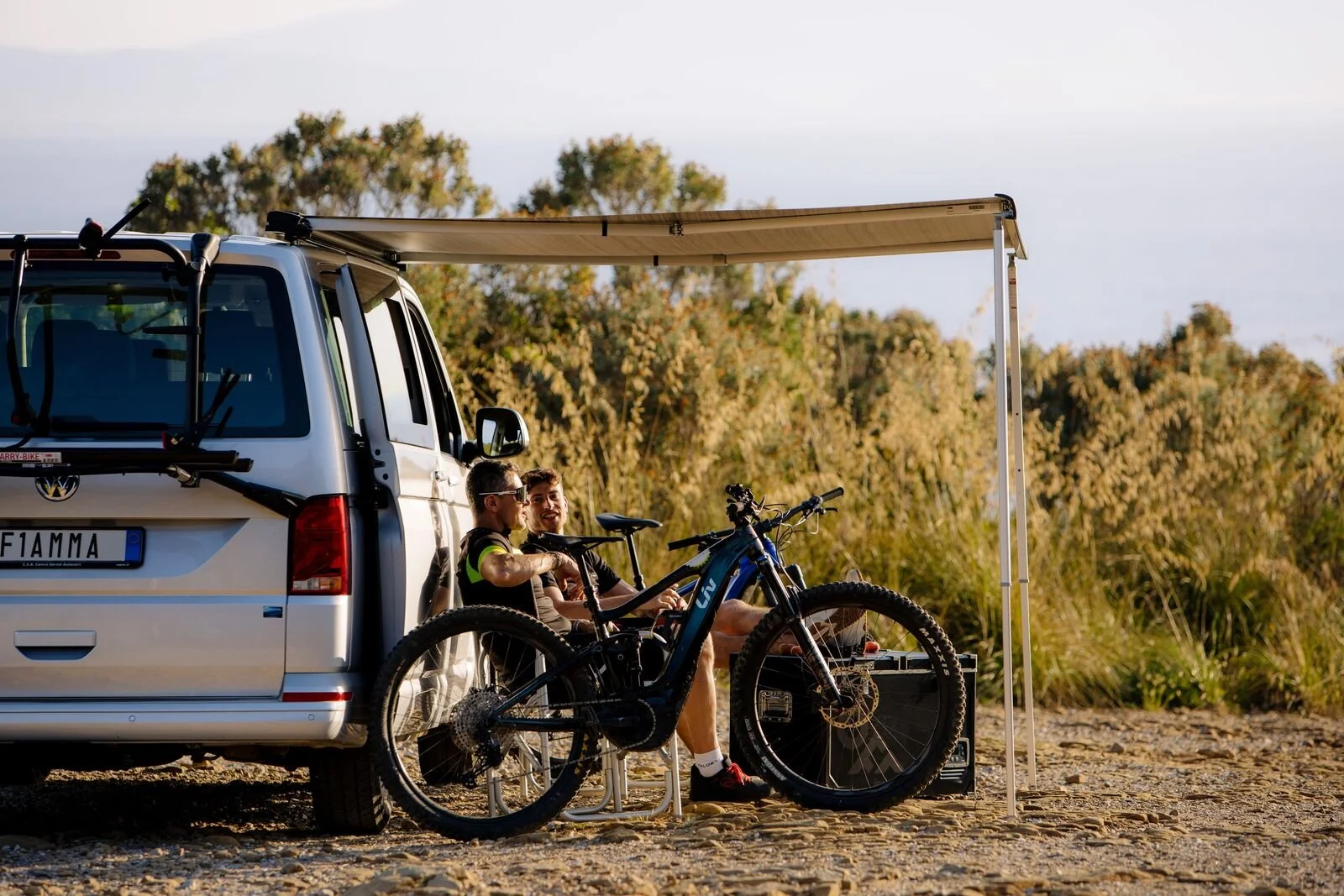
A drive-away awning attaches to the van via an awning rail system - commonly a Vamoose awning rail - and can be detached so you can drive away and return later.
It’s less about speed, and more about space.
The main benefits:
-
Feels more like an additional room than a canopy.
-
If you’re parked for several days, it becomes a base.
-
Useful on campsite trips or touring.
-
You can choose different awnings depending on trip type.
-
With just the rail fitted, the van remains clean and minimal.
What a Multi-Rail Actually Is (And What It Isn’t)
A multi-rail is a low-profile aluminium channel mounted along the roofline.
It’s designed to accept kador beading from drive-away awnings, sail shades, or lightweight canopies.
On its own, it doesn’t provide shelter - it’s a connection system.
It allows you to attach different types of awnings depending on the trip.
It can also be installed alongside a wind-out awning for added flexibility.
Why Some Owners Choose Rail-First
Cleaner van profile day-to-day
Full modular flexibility
Lighter overall setup
Ability to choose different awnings depending on the trip
For active travellers or those who value flexibility over instant deployment, a rail-first approach often makes more sense.
Quick Comparison: Wind-Out vs Multi-Rail + Drive-Away
If you're deciding between a wind-out awning and a multi-rail setup, this is how they compare in practical, real-world use:
| Feature | Wind-Out Awning | Multi-Rail + Drive-Away |
|---|---|---|
| Permanently mounted | Yes (always on van) | Rail only (awning detachable) |
| Setup time | 1–2 minutes | 5–20 minutes depending on setup |
| Interior storage needed | None | Required for fabric & poles |
| Ideal for | Weekend trips & frequent moves | 3+ night stays & basecamp setups |
| Modular flexibility | Limited | High (multiple awning options) |
| Wind performance | Good when secured | Varies by awning type |
Neither option is automatically better - the right choice depends on how often you move, how long you stay, and how you use your outdoor space.
-
A wind-out awning often works better if:
Most trips are weekends or short breaks
You move locations frequently
You mainly want shelter for cooking or shade
Speed and simplicity matter most
You want something you’ll use every single trip
For many UK campervan owners - especially around Cornwall and the South West - this option gets used far more often because it’s effortless.
-
A larger, more structured awning (like a drive-away) often makes sense if:
You stay in one place for multiple days
You want a consistent outdoor “room”
You travel with children and need extra space
You use campsites regularly
You don’t mind setup time in exchange for coverage
For families or longer touring trips, the extra enclosed space can transform the experience.
Real-World Factors That Change the Decision
Most buying advice focuses on features.
In reality, the right choice usually comes down to four practical factors. If you work through these honestly, the decision becomes far clearer.
Travel Pattern
How you actually travel matters more than how you imagine you travel.
If most trips look like:
One or two nights
Frequent location changes
Coastal stop-offs
Short breaks
…a fast wind-out awning often gets used far more consistently.
If your trips look more like:
3–5 nights in one place
Campsite-based touring
Treating the van as a basecamp
Wanting a defined outdoor “room”
…a drive-away setup can add meaningful living space.
If you move more than once per day, a drive-away setup quickly becomes inconvenient.
Roof Type Matters
Your roof setup quietly dictates more than most people realise. Pop-tops may conflict with rail height and mounting positions - you need the correct fixings for your existing setup. A rail that’s too high may not seal properly.
A standard panel van gives more mounting flexibility.
A pop-top requires careful positioning to avoid interfering with lifting mechanisms, hinges, and seals.
A high-top changes mounting height and awning reach.
Storage Constraints
Drive-away awnings create more space outside - but they take space inside.
Fabric, poles, ground sheets and accessories need somewhere to live when packed away.
If your van already carries:
Bikes
Surfboards
Camping gear
Children’s equipment
Dogs
A permanently mounted wind-out awning adds no interior bulk.
A drive-away setup requires planning for where it goes when not in use.
Weather Exposure
As we all know, Cornish clifftop wind is not the same as a sheltered campsite field.
If you regularly park in exposed coastal locations:
Wind loading becomes important
Setup time matters more
Simplicity often wins
On exposed Cornish headlands, simpler and faster systems often prove more practical.
If you mostly use managed campsites with wind protection, larger drive-away systems become more practical.
When you look at roof type, travel pattern, storage, and weather together, the decision usually stops being confusing.
When Neither Option May Be Necessary
Some campervan owners don’t need a permanent awning setup at all. Particularly if…
You rarely sit outside the van
You mainly use serviced campsites with facilities
You move daily and don’t set up outdoor space
You prefer minimalist travel
For many, usable outdoor space transforms trips - but it should fit how you actually travel.
Installation Considerations Most Buyers Overlook
Choosing the right awning isn’t just about size or style. How it’s fitted - and what it’s fitted to - makes a bigger difference than most people realise.
Fitment differs between vans such as the VW Transporter, Ford Transit Custom, Crafter and Sprinter - particularly when pop-tops or roof accessories are involved.
Here are the installation details that genuinely affect long-term performance.
-
Not all campervan roofs are the same.
For example, a VW Transporter pop-top requires very different mounting clearance compared to a high-roof Crafter or Sprinter.
Pop-tops, in particular, require careful positioning. The awning or rail must sit:
Clear of the lifting mechanism
Clear of hinges and fabric bellows
At the correct height to allow smooth operation
Without interfering with roof seals
Mounting too low can restrict movement.
Mounting too high can affect stability and alignment.Rail height also affects drive-away awning compatibility.
This is why awning installation should always be planned around the specific van model and roof setup - not treated as a universal fit.
-
An awning that’s even slightly misaligned can cause ongoing frustration. Poor alignment or incorrect sealing can lead to water ingress or long-term stress on mounting points.
If the angle is wrong:
Rainwater pools instead of running off
Fabric stretches unevenly
Wind stress increases on one side
The awning never quite feels “right”
Correct installation means:
Level horizontal alignment along the van body
Slight forward pitch when deployed
Consideration of drainage direction
In UK conditions - especially frequent rain - proper alignment is the difference between usable shelter and constant adjustment.
-
Coastal conditions are different.
Clifftops, beaches, and exposed car parks experience stronger and more unpredictable wind than inland campsites.
Wind loading affects:
Bracket choice
Fixing method
Mounting points
Sealant durability
A large wind-out awning creates leverage in strong gusts.
That doesn’t make it unsuitable - it just means installation must account for real-world exposure.The goal isn’t “will it survive a storm?”
It’s “will it stay solid and reliable during normal coastal use?” -
More vans now run roof-mounted solar.
Awning placement must consider the campervan solar installation:
Panel position
Cable entry glands
Future expansion
Shadow impact when deployed
A poorly positioned awning can block sunlight or limit access for maintenance.
Equally, installing solar after an awning without planning can create spacing conflicts.
The best approach is to view the roof as a system - not separate upgrades fitted at different times without coordination.
-
A permanently mounted wind-out awning adds weight to one side of the van.
While the difference isn’t dramatic, correct mounting matters for:
Even load distribution
Structural support
Long-term body integrity
Proper fixing avoids:
Flex in the bodywork
Stress around mounting points
Seal failure over time
Wind-out awnings require structural mounting points, while rails require precise height alignment.
It’s also important to use mounting methods suited to the van’s construction - not generic brackets used across multiple vehicle types.
Can You Start Simple and Upgrade Later?
Yes - and many people do.
One of the biggest misconceptions around campervan awnings is that you have to make a permanent, all-or-nothing decision. You don’t.
There are three common approaches.
-
Some van owners install a multi-rail first to keep options open.
A rail allows you to:
Attach sail shades
Use lightweight canopies
Add a drive-away awning later
It’s low-profile, discreet, and flexible.
This approach suits people who:
Aren’t sure how they’ll use the van long-term
Prefer modular setups
Want minimal visual impact day-to-day
It keeps future upgrades simple without committing to a full wind-out system immediately.
-
Others start with a permanently mounted wind-out awning.
This gives:
Instant shelter
Everyday convenience
No interior storage impact
Later, many people add:
Side panels
Privacy rooms
Additional rail systems
For frequent movers and weekend travellers, this often becomes the most-used upgrade on the van.
-
Some vans run both a wind-out awning and a rail.
This allows:
Quick shade from the wind-out
Occasional drive-away setup when staying longer
Maximum flexibility
Sometimes a multi-rail isn’t chosen for flexibility - it’s chosen because it’s the correct fitting method for the van.
It isn’t necessary for everyone - but for families or long-term tourers, it can make sense.
Frequently Asked Questions
Do I really need a campervan awning?
Not always. It depends on how long you stay in one place, how often you move, and whether you value speed and simplicity over maximum coverage.
What’s the difference between a campervan awning and a multi-rail awning system?
A full awning creates a larger outdoor room, while a rail allows flexible attachment of lighter shelters, canopies, or drive-away options.
Are campervan awnings worth it in the UK climate?
They can be - but only if the setup suits UK wind, rain, and short-trip travel. Many people benefit more from simpler shelter options.
What’s the biggest mistake people make with campervan awnings?
Buying based on size or specs rather than how often they’ll actually use it.
Buying based on size, not usage
Ignoring setup time reality
Overestimating how often you’ll pitch a drive-away
Not considering wind exposure
Choosing DIY fitting without sealing knowledge
Making the Decision Feel Easier
Some people genuinely benefit from a larger, drive-away setup. Others are far better served by a fast, integrated wind-out awning.
Neither is automatically better.
The right campervan awning isn’t about features.
It’s about how you actually travel.
Once you’re confident which setup suits your travel style, the next step is ensuring it’s fitted correctly - aligned, sealed, and positioned to work with your roof type, pop-top, and any existing solar setup. We install Fiamma wind-out awnings and Vamoose multi-rails in Cornwall, helping you get the setup right first time.